Wednesday, 16 January 2019

The 1929 Ommanney tree

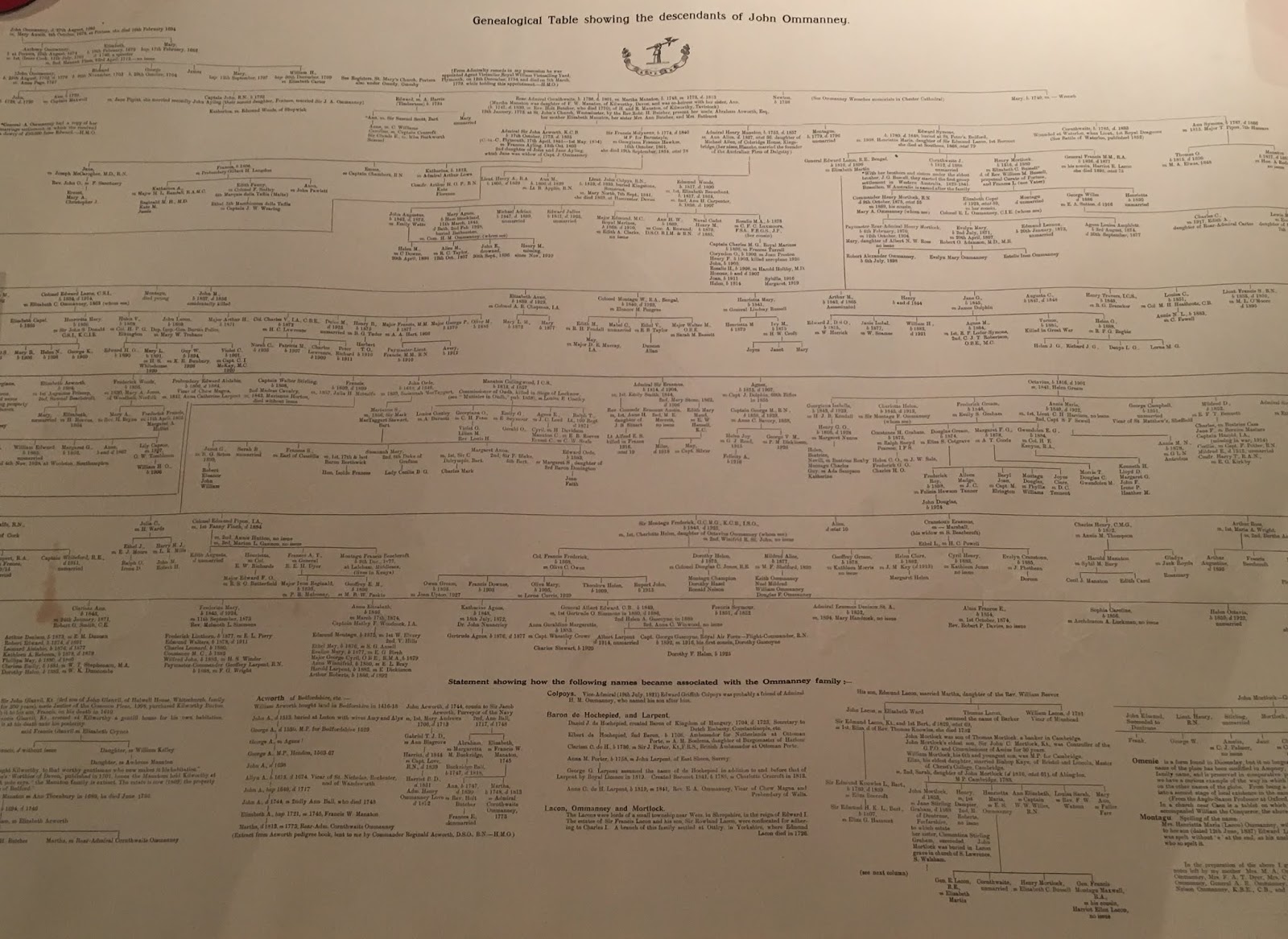
Some time ago - so long that I had forgotten until I was recently reminded of it - I saw a listing in a library suggesting that they held a large Ommanney family tree from the early 20th century. I had for a while intended to motor down there and take a look, but I never quite got round to it. No matter. I have recently received a series of photographs of this same document from an Ommanney descendant who also has a copy (my thanks to Jayne, and her brother).

It has set several hares running and I will be producing an update of my document Descendents of Admiral Cornthwaite Ommanney shortly. Somehow, once you have a tip-off in genealogy, it is much easier to track down further details. And the 1929 tree is a hatful of tip-offs.

What is most striking is just how accurate it is. Of course, in 1929 they were closer to the action than we are now. But I can sit here calling up all sorts of documentation from the 18th to the 20th centuries at the touch of a button; they had to pack a dozen valises and jump into the Bentley for a weekend jaunt down to the library at Portsmouth to achive the same thing. And yet almost every new detail on the tree is backed up by all the evidence I can muster. It is most impressive.

Genealogical Table Showing the Descendants of John Ommanney
Produced by Henry Mortlock Ommanney, 1929

John Ommanney was Cornthwaite’s great-grandfather. It seems though that every more recent Ommanney can be traced back to Cornthwaite rather than to his brothers or uncles.

Tuesday, 20 February 2018

Rev. Edward Aislabie Ommanney

The portrait below has recently been made available by the National Portrait Gallery.


A number of other Ommannies are in their collection but not yet digitised. These include Honoria Catherine Ommanney and three more shots of Francis Downes Ommanney. I don’t know what their timetable is but it looks like they are working their way through them. If they are doing it alphabetically, we might expect them very soon.

BA (1827) / MA (1831) Exeter College Oxford 
Deacon: 20 December 1829, London
Curate: 22 December 1829, Mortlake
Priest: 19 September 1830, Cantebury
Perpetual Curate: 14 December 1832, Mortlake
Later Prebendary of Wells Cathedral (1848) and Rural Dean of Chew Magna (1850).
On 15 July 1841 he married Anna Catherine de Hochepied Larpent (20 June 1819 – 14 December 1893) at Wandsworth.
Author of Plain Advice to Persons who have been Lately Confirmed by the Bishop (1863). His advice probably did not extend to family planning, as he had twelve children between 1842 and 1861.
Died 21 January 1884. An obituary was published in The Times on 24 January 1884

Wednesday, 15 November 2017

Mrs Nettleton's School: UPDATE

I have received a few helpful pointers following my previous post, most of all from Giles Colchester, a descendent of the Nettletons who knows more about the school than I expected to find out.

Courtesy of him, here are four picture of what Francis Ommanney called that "huge, red brick, hideous house and the level expanse of playing field that lay behind it":


It turns out that Mrs Nettleton's school at Stonefleet was destined to become Feltonfleet, which moved to Cobham, Surrey in 1917, to escape the airship bombs. It is still there. I ought to have known, as my brother-in-law was a pupil. It's funny how these things turn out. 

January 2019: a further update. For photographs of some of the Feltonfleet school sports teams from the 1908-1911 period, please see https://www.flickr.com/gp/sjm_1974/39eQu8

Sunday, 22 October 2017

Mrs Nettleton's School, Folkestone: the class of 1911

I have an idea for something called Reverse Genealogy. Perhaps it already exists, but if so, I haven't found it.

Normally in genealogy you go looking for information on the people you are interested in. The limitation is that you can only ever hope to find things that are somehow directly connected with those names. 

In reverse genealogy, you have some information, and then you set about the fairly simple task of finding the people descended from those concerned, and then you wave it in their faces.

Here's an example. Francis Downes Ommanney wrote a detailed description of his school days at a boarding school in Folkestone in his autobiography The House in the Park. I found my way to this book rather easily, because it happened to be my (distant) relative who wrote it, and whose name pops up in the library catalogue.

But if you're descended from Ommanney's schoolmate Poulton Major you're very unlikely to find this material. Ommanney is hardly a household name, after all. Poulton Major and the account in the book cannot be linked by even the most painstaking genealogist, partly because the book is never read, but mostly because Poulton Major is a pseudonym. 

How do I know? Because they were at school when the 1911 census trundled past.

Here's the census of 2nd April 1911, with the seven year old Francis Ommanney, his brother, and the other boys:


It must have been Francis's first term, because his brother Owen is there, and Francis writes in the book 'Both my brother and his friend left at the end of my first term'.

What about those pseudonyms? Well, unfortunately the boys are generally anonymous, but the teachers appear in detail. The hierarchy of cook and matron and Headmaster is dutifully preserved in the census, and enables us to compile the following list:

CENSUS                                                                            BOOK
Harry Thomas Nettleton (Head):                                       'Old Mr Shuttleworth'
George Nettleton (son of HTN), born c.1871:                   'Edward Shuttleworth'
[His sister seems to have been absent for the 1911 census]
Caroline Wood (nurse - school matron), born c. 1875:      'Miss Watson'
Eliza King (cook), born c. 1877
Louisa Bird (housemaid), born c. 1883
Herbert Jeffery (teacher), born c.1876:                              'Mr Simpson'

There is just enough similarity between the pseudonyms and the real names (Nettleton/Shuttleworth; Wood/Watson) to reassure me I'm on the right track.

The pupils (and approximate birth year, based on ages) are:

Cecil Lillie (1898)
Guy Reeves (1902)
Ernest Ashworth (1900)
Joseph Badeley (1899)
Owen Ommanney (1899)
Basil Colchester (1900)
William Ashworth (1899)
Robert Ferrier (1900)
Harold Porter (Pater?) (1900)
Charles Porter/Pater (1901)
Ronald Selby (1900)
Llewellyn Jones (1901)
Raymond Wickham (1902)
Ronald Pitt (1902)
Francis Ommanney (1903)

It's tempting to hypothesise that Harold Porter might be the Poulton Major of the book, as he appears to have had a younger brother, and he is of an age with Owen Ommanney, and there is a similarity in the surname along the lines of those used for the adults. But perhaps that's a step too far.

FDO mentions in the book that there were about 40 pupils; it is not clear why there are only fifteen on the census sheet. (The next page of the census begins with a girls' school, but there is no indication in the book that it was a mixed school, so perhaps that was another institution down the road).

The Head's wife, Julia Browne ('old Mrs Shuttleworth'), does not appear in the census because she died in November 1910. This is recounted in FDO's book, as he met her on an earlier visit to the school.

The text of the school chapters are in the attached PDF.  If you're taken with it, the whole book can be found in online bookshops for a song.


Tuesday, 31 March 2015

1850s photographs of Manaton Collingwood Ommanney and family

The Lucknow Album, held in the British Library, is a photographic record of prominent residents of Lucknow, both European and Indian, directly before the siege of 1857.  The album was formerly owned by The Times' war correspondent William H. Russell, who was presented with it by Captain Trevor Wheler. The bookplate has the inscription: 'HeadQuarters Camp Dilkoosha Lucknow March 15th 1858. Presented to me by Trevor Wheler [signed] W.H.Russell.' The album was compiled before the Siege of Lucknow (May 1857) and features the work of a local photographer, Ahmad Ali Khan, from 1856 and early 1857. Many of the prints are annotated by hand, presumably by Wheler and Russell, giving the names of the sitters, and sometimes their fate in the siege.

The British Library has just changed its policy on readers taking photographs of material in the Asian and African reading room (March 2015), which enables me to include the following pictures of Manaton Collingwood Ommanney, Judicial Commissioner of Oude, with members of his family and circle of friends.


Manaton Collingwood Ommanney, with his wife Louisa Costley (seated, centre) and two daughters (standing, left and right). Salt Paper print, 97x85mm. Miss White is at back centre and Mrs Kirk front right. The photograph is annotated 'How many? Oh, mercy!'


Manaton Collingwood Ommanney was born on 19 March 1813. His father was Sir Francis Ommanney, Navy Agent and MP for Barnstaple, and his siblings included Admiral Sir Erasmus Ommanney, Major Octavius Ommanney, and Captain Walter Stirling Ommanney, all of whom feature elsewhere in this blog. He was to spend 26 years in the Bengal Civil Service between 1831 and his death at the siege of Lucknow in 1857. He had by that time risen to become Civil Service Judicial Commissioner at Oude.

He married Louisa Engleheat Costley on 1 November 1834 at Jubulpoor, and they had six children, including Georgiana Ouseley Ommanney (born 1837); Agnes Elizabeth Ommanney (born 1845); Manaton Francis Ommanney (1847-1861), and Ralph Thomason Ommanney (1852-1872).


Louisa Ommanney, nee Costley. By the time of the siege she was reportedly an invalid. 


The following details of Manaton's dramatic death are taken from the Perlustration of Great Yarmouth by Charles John Palmer, (1872); A Widow’s Reminiscences of the Siege of Lucknow (London, James Nisbet & Co, 1858); A Personal Narrative of the Siege of Lucknow by L.E. Ruutz Rees (1858); and The Siege of Lucknow – a Diary by the Hon. Lady Inglis (James R Osgood, London, 1892).

On 4 July 1857 Ommanney was sitting in his room, soon after the commencement of the siege, with Sergeant-Major Watson. The double-storied house was only lightly defended, surrounded by a deep ditch and a hedge of cactus. Additionally, it had two guns to sweep the road between Gubbin’s Post and the Sikh Square, in case Gubbin’s was overrun. It was considered safe enough – Brigadier Inglis made his headquarters there after the death of Sir Henry Lawrence, and later Henry Havelock and his staff made it their residence.

As he sat there, Ommanney was struck on the head by a cannon ball, which 'scattered a portion of his brains'. Although he did not die immediately, there was no expectation that he would recover. The sergeant-major died almost at once, although it did not appear that the ball had touched him. Ommanney died four days later. 'Ommanney's House' (or the remnants of it) is still so named.

The two daughters who were present at the siege, and who feature in these photographs, were engaged to the Cunliffe brothers; the first, Mr. Cunliffe of the artillery, died in the siege; the second, a civilian, died at Byram Ghat.


The Misses Ommanney, with an unidentified companion. One of these could presumably be Georgiana, who would have been in her late teens. Could their companion be one of the Mr Cunliffes?


At first, the rumour spread abroad that all the whole family had been killed:

Exeter and Plymouth Gazette, Saturday 21 November 1857
Mr Ommanney, the civil superintendant of Oude, with his wife and two daughters, have perished at Lucknow. Mr Ommanney is brother to the Rev. Prebendary Ommanney, of Chew Magna, near Bristol.

This was incorrect. Louisa Ommanney and the two girls arrived at Southampton in the Peninsular and Oriental Company’s steamer Pera on 22 April 1858, as recorded in the Bath Chronicle of that date.

Lady Inglis in her diary of the siege wrote that:

Steady rain all day. Several desertions took place from the garrison; one could hardly wonder at it. Mr. Cunliffe, artillery, died of fever; he was engaged to one of the Miss Ommanneys; and his brother, a civilian, who had been killed in the district, had been engaged to the other. Poor girls! their father had died during the siege, and their mother was a confirmed invalid and required all their attention. I did not know them, but heard that their conduct was most praiseworthy, and that they bore their troubles nobly. (Entry for 22 September 1857)


The 'poor girls' (centre and right), with Miss White (in black).


The inscription on Ommanney's memorial, which still stands at Lucknow, reads:


Sacred to the memory of
Manaton Collingwood Ommanney Esq
For 26 Years in the Bengal Civil Service
The sixth son of Sir F. M Ommanney Bt
and Georgina Frances his wife
He was born March 19th 1816 and died July 8th 1857 
From the effects of a round of shot during the memorable defence of Lucknow in the province
of Oudh of which he was the Judicial Commissioner
Leaving a widow and six children to sorrow
Not without hope for one thus suddenly cut off in his career of Christian integrity, benevolence and usefulness beloved by themselves
and esteemed by all who knew him
The righteous is taken away from the evil to come 
Isaiah 57th Ch (16) Verse


Miss Ommanney (most likely Georgiana)


The Bath Chronicle and Weekly Gazette of 24 May 1924 recounts a talk by a survivor of the siege of Lucknow, a Mrs Huxham, in which she refers to Ommanney as ‘one of the best and most able leaders of the garrison.’ She also referred to a letter in the possession of Brigadier-General Albert Edward Ommanney, written by Manaton during the siege. It was addressed to Sir Albert de H. Larpent at Calcutta, and had been enclosed in a quill and smuggled out of Lucknow by a native Indian. It included the following passage: “No rain here, and cholera prevalent. Plague, pestilence, famine and sword impend, but all females and males are in good health and spirits.”

Louise and three of the children (Agnes, Manaton and Ralph) made it out, and can be found in the 1861 census back in England.  Manaton (younger) died a few weeks after the census; Ralph died at 19 years old in 1872, an Ensign in the 107th Regiment.


Louisa (of 35 Kildare Terrace, London) died on 18 January 1892.

Tuesday, 24 February 2015

The longevity of Admiral Sir Erasmus Ommanney


Admiral Sir Erasmus Ommanney
'Father of the British Navy'

Born in London on 22 May 1814, Erasmus Ommanney arguably became the most significant naval figure in the family’s history.

The twelve year-old Erasmus entered the Navy in August 1826 under his uncle, John Acworth Ommanney, then Captain of HMS Albion. On 20 October 1827, when only 13, he took part in the Battle of Navarino. Over the succeeding decades the captured flag of the Turkish Commander-in-Chief was handed down by seniority among the surviving officers until 1890, when Ommanney, the sole survivor of the action, presented it to King George I of Greece.

Longevity alone would perhaps not have been sufficient to earn him the title of 'Father of the British Navy' seventy years later; but an early start at an iconic engagement (and Navarino was the last major naval engagement fought entirely under sail) was certainly enough to secure it. To the Edwardians who scanned their morning papers for news of Admiral Ommanney's health in his declining years, Navarino must have seemed impossibly remote.

In response to a question on the identity of Britain’s oldest surviving military officer, the following appeared in Notes and Queries on 2 July 1904:

OUR OLDEST MILITARY OFFICER
According to Hart's 'Army List' for 1904, there was still living on 31 December 1903, General Charles Algernon Lewis, of the North Staffordshire Regiment (64th Foot), whose first commission was dated 13 October, 1825, as well as General Henry Carr Tats, of the Royal Marine Artillery, whose dates from 30 June, 1829; but it is possible that even these are not the oldest surviving military officers. In regard to the senior service, the Royal Navy list for April, 1901, gives Admiral Sir Erasmus Ommanney as having entered the navy in August, 1826; Admiral Sir Edward Fanshawe in September, 1828; and Admiral Sir Arthur Farquhar on 13 March, 1829; and of these Admiral Ommanney is specially to be noted as having taken part in the battle of Navarino in 1827.


Erasmus Ommanney’s visiting card, 1900.
The reverse reads: Navarin – 1827. Arctic service – 1836. Discovered the 1850-57 first traces ever found of Franklin’s missing ships 23rd August 1850. Russian War commanded the Naval force in the White Sea 1854 1855. Served in the Baltic. Commanded the force in the Gulf of Riga – repulsed a flotilla of Russian Gun Boats under cover of the Batteries.


Ommanney died on 21 December 1904 at his son’s home, St Michael's vicarage, St Michael's Road, Southsea, Hampshire, and was buried in Old Mortlake Cemetery. He was 90. It had been a very public decline, with frequent press bulletins as to his health as far back as May 1903. The Aberdeen Journal of 22 December said that he “had been ill for some time... He had been lying almost unconscious at his son’s house for a considerable time, and a change for the worse set in on Sunday”.

Pre-prepared obituaries flew off the editors' shelves, and competed to find the most effective way of expressing the Admiral's links with the distant past:
 

[text of article left]

Admiral Sir Erasmus Ommanney was born in the year before the battle of Waterloo, on May 22, 1814, and entered the Navy in August, 1826, eleven years before Queen Victoria came to the throne. He was the son of Sir Francis Molyneux Ommanney, M.P. for Barnstaple and Navy Agent. His first ship was the Albion, a famous seventy-four of the Napoleonic War, built while Nelson was alive, and in her, as a midshipman, he had his first experience of fighting – at the battle of Navarino. At Navarino the Albion was in the hottest of the fighting, and was run alongside of by a Turkish two-decker, whose men swarmed on board en masse in a desperate attempt to capture the vessel. [...text missing in original..]. task he fought a smart action with a flotilla of Russian gunboats, which he defeated and drove out from under the shelter of some heavy shore batteries. After the war, Sir Erasmus Ommanney served successively in the West Indies, in the Channel, and the Mediterranean, as captain of the Brunswick, of eighty guns. Our portrait is by Russell and Sons, Southsea.

West Gippsland Gazette, June 30th 1903
A NAVAL VETERAN SIR ERASMUS OMMANNEY.
Sir Erasumus Ommanney, who was lying ill on May 18th, is one of the oldest sailors who have sailed under the British flag. He is an astonishing link with the historic past. He was in the King's Navy when Lord Liverpool was Prime Minister of England, and was fighting for his country before the grass had grown over Canning's grave. George the Fourth was on the Throne when he received his baptism of fire at Navarino, and it is amazing to remember that that battle was fought all but eighty years ago. Sir Erasmus Ommanney was there, under the command of Admiral Codrington, and he is perhaps, the only man now living who would give us a first hand description of what the Duke of Wellington called "that untoward event." Admiral Ommanney, in those far-off days, assisted at the landing of the British Army in Lisbon, helped to destroy the Turkish Fleet at Navarino, was on the yacht which conveyed Queen Adelaide to Holland and back, and explored the Arctics in search of the missing whalers under Sir James Ross. Few men can look back so far and say, "I was alive then"; but how many can look back, one wonders, and say, "I was present at that event?" Admiral Ommanney, seventy years ago and more, was helping to shape the history of the world. He is perhaps the only officer who has fought for England side by side with Russia and against her. He had around him at Navarino French and Russian troops, concentrating their strength upon the destruction of the Turkish and Egyptian fleet, and in later years, in the Crimea, he found himself commanding vessels whose guns were turned against his old comrades. He was closely associated with the fortunes of Greece in the early years of last century, and was at Athens during the revolution of 1844 and the establishment of the Constitution which followed. It would be almost as easy to say what Admiral Ommanney has not done as to say what he has done. It was he who found the first traces ever discovered of Sir John Franklin's lost ships. He spent the winter of 1850 as near the North Pole as he could get, and was sixty days in travelling 500 miles over the ice. His exploration of the coast added something to our knowledge of the Arctics. He has been at the other side of the world, too. Before Queen Victoria came to the throne Sir Erasmus Omrnanney was searching the Antarctic world for lost whaling crews. He was under the son of Sir John Ross, and has vivid memories of the winter he spent in Baffin's Bay and along the coasts of Greenland and Labrador. He has medals for these services to peace as well as distinctions for heroism in war, and it is not surprising that such a man has more letters after his name than there are in the alphabet. If he were well enough to follow it, Admiral Ommanney would be interested in the dawn of a new era in Ireland. There is hardly a place between the Poles which he has not known in the course of his wonderful life, and he has been in Ireland too. More than half a century ago he was there during a famine, helping to alleviate the sufferings of the people...


For all that, his funeral was a remarkably restrained affair:

Portmouth Evening News, 28 December 1904
A fog hung over Mortlake on Tuesday afternoon when the remains of the late Admiral Ommanney were laid to rest. The coffin was brought to Wimbledon station, and thence by road to Mortlake Cemetery. In the same train travelled the Rev EA Ommanney (the eldest son), Mr E W Hansell (son- in-law), Commander E D Ommanney (a nephew), and a bearer party from the Royal Naval Barracks, Ports. At the graveside, awaiting the arrival of the coffin were Colonel Albert Ommanney, Captain Ommanney, Mr Charles Ommanney CMG, and Sir Montagu Ommanney (nephews), Colonel Monagu Ommanney and Colonel Edward Ommannel (cousins), Mr Edmund F T Bennett (a nephew by marriage) and Admiral Sir Digby Morant... The coffin, still covered with a Union flag, and having on it the late Admiral’s cocked hat, sword, and scimitar – a Navarino trophy, which he highly prized – was borne from the hearse to the grave by six bluejackets. The seventh man of the party walked behind the coffin, and carried a cushion on which rested the late Admiral’s orders and medals.

Sunday, 22 February 2015

The Curse of Manaton


Admiral Cornthwaite Ommanney married Martha Manaton in 1773. Every English Ommanney I have found can be traced back to Cornthwaite and Martha, and it seems that they remembered her because 'Manaton' reappears frequently as a given name in the succeeding generations.

For such a successful family, though, it is remarkable how much bad luck seems to have fallen into the path of those Ommanneys with the Manaton name. With the notable exception of Admiral Henry Manaton Ommanney (1778-1857), who somehow managed to live a full and successful life*, other Manatons met an unfortunate fate:

Manaton Collingwood Ommanney (1813-1857) died at the siege of Lucknow. According to A Personal Narrative of the Siege of Lucknow by L.E. Ruutz Rees (1858), 'he was quietly sitting in his chair when a cannon ball hit him on the head and scattered a portion of his brains...', which seems unlucky, even in a siege. He died shortly after. His wife and daughters made it out alive, and will be the subjects of another post.

Ernest Manaton Ommanney, son of Francis Ommanney and Julia Metcalfe, died in Brighton at the age of ten in 1862.

Manaton Francis Ommanney, son of Manaton Collingwood Ommanney, was not present at the Siege of Lucknow, but died in England just a few weeks after appearing in the 1861 census, at age 13.       
       
Octavia Manaton Ommanney (1856-1928) lived a long life, but as the only spinster among her sisters was left with the task of nursing the irascible Octavius Ommanney (of whom much more is said in another post) through his long declining years as an invalid. When he died in 1901, poor Octavia was handed the task of nursemaiding her great-nephews and nieces.

Arthur Manaton Ommanney (born 21 November 1842) was randomly murdered in Bengal in October 1865:

Waterford Chronicle, 1 December 1865
MURDER OF A BRITISH OFFICER IN INDIA
Another victim has fallen by the hand of a fanatic assassin on the frontier (says the Lahore Chronicle of October 7). Arthur Manaton Ommanney Lieut. in the Cavalry of the Guide Corps stationed at Murdan, was riding on the evening of the 3r inst. past the house in which the band practices, when a Musselman approached him saying he had a petition to make; at the same time, seizing the horse’s rein he stabbed poor Ommonney with a knife under the right armpit. The murderer was immediately apprehended by the bandsmen, and is now in safe custody. He states that he is a native of Bela, near Jelallahad, a follower of Synd Moharuk Shah of Mulkah and had come to Murdan with the express determination of taking the life of a “Feringhee” in revenge for the burding of Mulkah, during the Umbeylah campaign. After the above was in type we received information that the murderer, having been convicted on the clearest evidence, was hanged on the 5th inst.

Henry Manaton Ommanney (1871-1910) died in his 30s.

Harold Manaton Ommanney (1884-1965) was imprisoned for, and ruined by, fraud.

Yorkshire Evening Post, 28 June 1939
PENAL SERVITUDE FOR SOLICITOR
CLIENTS’ MONEY “CRUELLY PLUNDERED” FOR YEARS
Harold Manaton Ommanney (55), partner in a firm of London solicitors, flushed and bowed his head in the dock at the Old Bailey to-day when Mr Justice Hilbery told him: “For years and years you have been cruelly plundering your clients”. ...Detective-Inspector Journing said that Ommanney was married with a son and a daughter. From 1914 to 1919 he served as an able seaman in the RNVR...
Mr G D Roberts, for the defence, said Ommanney did not wish to try to shift the responsibility for what he admitted onto other shoulders. It was clear from the tragic history of the case that the overdrawings started in 1917, before Ommanney was an active member of the firm.
Ommanney was away on active service until he was demobilised in February, 1919. The overdrawings started in a comparatively small way, and when Ommanney came back he ought to have stopped them, but he was too weak. Each year the position became worse and each year he became less capable of taking that strong action.
From small beginnings the fraud grew and grew. Ommanney was now utterly and completely ruined.
Passing sentence, Mr Justice Hilbery said the prisoner... began with an education which put him into surroundings where the influences brought to bear on him could be nothing but the best. From those bright beginnings he stood now disgraced, ruined and in the shadow of gaol...

Harold Manaton Ommanney was sentenced to five years’ imprisonment on 28 June 1939. He was struck off in November 1939.


*Mostly. He did have to watch his son being court-martialled and demoted, permanently as it turned out, according to one source because of a disagreement with Admiral Ommanney himself.