Son of Francis Molyneux Ommanney, sometime MP for Barnstaple, and Georgina Frances Hawkes, Walter Stirling Ommanney was born in 1808 and baptised on 13 September at Mortlake.
He became a Captain in the 2nd Madras Cavalry, and married Marianne Morton on 5 May 1842 at Calcutta.
The sole reason for this entry is the following fine watercolour which recently appeared on an auction house website:
A watercolour portrait of Captain W.S. Ommanney of the 2nd Regiment of Madras Light Cavalry. The Regiment was stationed initially at Jaulnah and then Kolapore before being ordered to Trichinoply. Ommanney appears to have joined the regiment in 1827 and is shown as on furlough in 1840. From the design of the lace on his collar it is clear that he is affiliated to one of the many regiments of Madras Light Cavalry that existed as part of the HEIC during the eighteenth and nineteenth centuries.
Captain Ommanney died 18 November 1866 at Bologne, France. At the time of his death he was living at 2 George Street, Portman Square, London. Marianne died on 19 November 1893.
Monday, 9 February 2015
Lieutenant Alfred Erasmus Stuart Ommanney
Born on 5 March 1897 at Portsmouth, Alfred Erasmus Stuart Ommanney was the only son of Erasmus Austin Ommanney, who was in turn the only son of Admiral Sir Erasmus Ommanney (1814-1904).
He was educated at Charterhouse (1911-1915), from where he was commissioned into The Buffs (East Kent Regiment) as a Second Lieutenant. He was sent to France on 8th July 1916.
He was killed in action at age 19, 8 October 1916, near Guerdecourt, during an attack on German trenches. He was buried on the battlefield and is listed on the Thiepval Memorial, Pier and Face 5D.
The William Holman Hunt sketch: the Mortlake Ommanneys
Helen Ommanney, née Gream (far left), and five of her children: Georgiana, Charlotte, Frederick, Annie Maria and Mildred. Of the children, we can only identify Frederick (seated) and Mildred (with the dog) on the basis of sex and age respectively. Georgiana, Charlotte and Annie Maria are indistinguishable.
The father of the family, Octavius, is absent; it is quite easy to imagine Captain Ommanney would not have seen eye-to-eye with the artist. Or perhaps he was too busy drilling his recruits on Sheen Common. Others of the children are also absent, including George Campbell Ommanney and (Admiral) Robert Nelson Ommanney.
The watermark on the sheet dates the drawing to 1862 at which point Hunt was actively looking for a wife; it is conceivable he was thinking of one of the Ommanney daughters in that connection.William Holman Hunt, Self Portrait (1867)
Helen Gream was born on 13 September 1814 at Rotherfield, Sussex, the seventh child of Rev. Robert and Maria Gream. She was christened on 23 January 1815.
Her upbringing would have been profoundly religious. Here is a description of her sister Katharine later in life, taken from A Greater Guilt: Constance Emilie Kent and the Road Murder by Noeline Kyle:
The woman who met Constance in the modest entrance to St Mary’s Convent was Miss Katharine Anne Gream, Lady Superior of the convent since 1857. The tenth child of the Rev. Robert Gream, Anglican Rector of St James, London, and then of Rotherfield, Sussex, Katharine Gream was forty-one years of age in 1864. Like Constance, she had been born into an Anglican family, but she and her siblings were baptised Roman Catholic. Educated at home by her father, she left to enter the sisters of St Mary, Sisterhood and Obedience at St Mary’s, Brighton. Although Constance stood outside the religious and spiritual fervour of the convent and its associated fanatical Anglo-Catholic doctrine, she could not help but be affected by it…
Helen’s siblings included two Mothers Superior and the Accoucher to the Princess of Wales.
Incidentally a Sir Francis and Lady Ommaney appear as characters in Charlotte M. Yonge's novel Stray Pearls (1883). Yonge has been called ‘the novelist of the Oxford Movement’; one has to wonder if there was a connection.
Georgiana Isabella Ommanney was born in 1843 and christened on 12th December. She married Henry J B Kendell and died on 23 August 1923 in Hertfordshire.
Charlotte (later Dame Charlotte) Helen Ommanney was born in 1845 and christened on 26th June. She went on to marry her distinguished cousin Sir Montagu Ommanney, who became Permanent Under-Secretary for the Colonies under the Campbell-Bannerman government. She died on 13 March 1913 at Wokingham.
Frederick Gream Ommanney was born in 1847, and christened on 11th December. On 26 April 1871 he married Emily Sophia Graham at Barnes. Frederick was at that time recorded as a navy agent.
He died at 42, on 5 June 1889:
Whitstable Times and Herne Bay Herald, 15 June 1889
Walmer has been in mourning, in consequence of the sudden death of Mr F G Ommanney, which took place at his residence, Sheen House, Upper Walmer, about eight o’clock on Wednesday evening, from typhoid fever contracted at Brussels. Mr F G Ommanney was a partner in the firm of Messrs Thompson and Son, brewers, at Walmer. Despite his busy life he found time to devote to parish matters, filling the office of churchwarden, and recently that of Chairman to the Walmer Local Board and the Deal and Walmer Conservative Association. In all public matters he took a prominent part.
His father, Octavius, is known to have been a frequent visitor to Brussels, but the reasons are obscure. Frederick bequeathed to his wife the plate presented to his father – presumably this refers to that given to Octavius Ommanney on his leaving Mortlake (of which more in another entry).
Annie Maria Ommanney was born in 1849.
On 1 November 1866 she married Charles Thomas Harrison of the Royal Engineers. Charles soon died, and the 1871 census already has Annie as an ‘officer’s widow’ at age 22.
The following announcement of her second marriage, in 1877, appeared (curiously) in the Australian press:
Sydney Morning Herald, June 26th, 1877
SEWELL — HARRISON. —April 10, at St. Mary's, Bloxham, by the Rev. G. C. Ommanney, M.A., brother of the bride, assisted by the Rev. J. Hodgson, M.A., Vicar of the Parish, Samuel Frederic Sewell, Esq., late Captain 61st Regiment, youngest son of the late Francis Theodore Dudley Sewell, Esq., of Wickhill House, Bracknell, Berks, Lieutenant, R.N., to Annie Maria, widow of the late Charles Thomas Harrison, Esq., Royal Engineers, and third daughter of Octavius Ommanney, Esq., J.P., of Bloxham, Oxfordshire, England.
By the time of the 1891 census she was again a widow. She died in 1922.
Mildred Dunine Ommanney was born and baptised on 8 August 1852.
She married Edmund F T Bennett, and died on 25 October 1933.
The Tribulations of Father Ommanney: Press reports of the Sheffield Ritualist affair, 1882-1883
Part four: the Hereafter
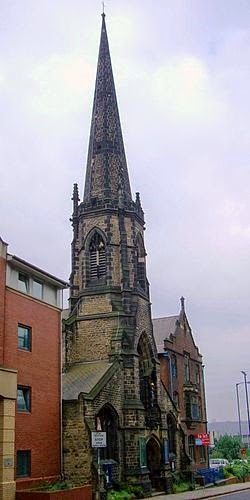
St Matthew's, Sheffield
The affair is over, but it still to be felt, here and there, in the years and decades to follow.
Sheffield Independent, 24 September 1884
The Rev. G. C. Ommanney... after expressing his thanks for the kind way in which the toast had been received...remarked that this annual festival gave him a great deal of
work, but still when it came it was a very great joy and happiness, because he saw around him many old friends who had supported him in times of trial and troubles, and who had been true to him and who now came to congratulate him upon increased prosperity.
But they must always remember that St. Matthew's was still on its trial. It had gone through one kind of trial, but it had still another to go through. They did not appear in the papers every now and then as having had a “scene at St. Matthew's.” (Laughter.)
They used to go to church on Sunday morning never knowing what was going to happen before evening, and next morning they would see on the placards of the newspapers large letters announcing “Scene and St. Matthew's; Parishioners ejected from the Church.” (Renewed
laughter). That sort of thing made it rather exciting. (Laughter.) They had not that trial now, but they were on their trial still—to see if they would carry out the far more important work of doing God's will in the parish, and of saving the souls of the
people committed to their care. (Applause)... It was a little more than two years ago since he came to St. Matthew's, and he thought all who had heard him preach during that time would allow that he had, as hard as he could, taught “the faith once delivered
to the Saints”— the old Catholic faith of the Church. At their first choral festival, Mr. Ebsworth, of Retford, came over to preach, and one thing which he then said had sunk into his mind ever since. Addressing the congregation, he said, “One thing your vicar
has to do during the coming year is to teach as hard as he can the Catholic faith.” He (Mr. Ommanney) had tried to do that as much as he possibly could. There was another thing which they had to do ,which was only second in importance to the teaching of the
Catholic faith, and that was the introduction of Catholic ritual. (Applause.)... For 1900 years the Church had always worshipped Him with great beauty and solemnity, and with a good deal of ritual. Were they now to think that in this 19th century
a new light ha been given to some few men in the Church, contradicting all that God had taught in the previous eighteen centuries? A few men now thought that God had to be worshipped in a bold and a plain way, that they were right, and that all the rest of
the church had always been wrong. After alluding in aid of the Church restoration and other parochial needs, Mr. Ommanney said they must go on in the way they had already pursued... Just before he went away for his holidays he was nominated a member of the
Sheffield Church Clerical Society, and in due time he was black-balled. (Laughter). Seven black balls would have excluded him, there were twenty-five—(renewed laughter)—but he felt highly honoured at the result. What amused him so much was a little report
which went about through most of the papers that the reason he was black-balled by the Sheffield Clerical Association was that he had acknowledged himself to be opposed to the principles of the Book of Common Prayer. (Laughter). He always thought—he might
be mistaken—but he had the idea that he tried to maintain and carry out those very principles. (Hear, hear). ...
Mr E. E. Bindley said he was present as the representative of the people of St. Matthew's parish, and he held the same office as a gentleman held last year who was absent
from their luncheon. (Laughter).
The CHAIRMAN, in responding, expressed a hope that before long St. Matthew's would be the centre of Catholicism in Sheffield, and that it would have a full ritual. (Hear,
hear.) He did not care who it was—the Archbishop, or any one from the queen downwards—there was no one who could stop the current of Catholicism. (Applause).
The proceedings then terminated.
Sheffield Independent,
17 November 1885
DR POTTER AND THE REV. G. C. OMMANNEY
The
following correspondence has taken place between the Rev. G. C.
Ommanney and the Rev. S. G. Potter, D.D., vicar of St Luke’s:—
St Matthew’s Clergy House, Sheffield, Oct. 27
My
dear sir,—There is a woman in your parish, named Varley, at Red Place
square, Gordon Street, who has a daughter ill, and has asked me to go
and see
her. I baptised the girl some time ago, and the mother is a regular
attendant at our mothers’ meetings, and at church. I did not like to
call on her without your permission, especially as some time (sic)
you expressed your wish that neither I nor my
coadjudicators should visit in your parish. But as the woman has
altogether attached herself to us, I should be very glad if you will
give me leave to go there. Of course in the event of you being kind
enough to do so, I shall only visit her, and not any of
her neighbours. —Believe me to be, yours sincerely, G. C. Ommanney.
[REPLY]
Oct. 27, 1885
Rev.
Sir,—In reply to your note I regret to be obliged to refuse my assent
to your exercising ministerial functions in this my parish. My habit is,
when
sent for from other parishes, to write to the vicar, or his curate
assistant, and point out the need of attention to one of their
parishioners.
By
birth and education I have the feelings of a gentleman, and would be
happy if I could do what you required, but the claims of truth forbid
the sacrificing
of it upon the altar of gentility. You have sworn to teach the doctrine
of the Thirty-nine Articles of our Church, ‘and none other,’and to
administer the doctrine and discipline of Christ as this Church and
realm have received the same. Yet you have openly
defied your Diocesan, the legal decisions of the Church courst of ‘this
realm’, and teach alien doctrines ‘contrary to God’s Holy Word,’ and so
the articles of the Church. You would, no doubt, teach this family the
idolatry to be abhorred of all faithful Christians,
and the ‘blasphemous fables and dangerous deceits of the Mass,’ and
fond or foolish things, vainly invented, denounced by our Articles. Can I
then seem to assent to such acts and teachings?
You
well know that our canons and rubrics bid you refer ‘strangers,’i.e.
non-parishioners, back to their own parish clergyman for spiritual
ministration.
The woman Varley and her daughter are looked after and attended to,
both temporally and spiritually.
—I have the honour to be, your obedient servant, S. G. Potter, D.D.
Yorkshire Post and Leeds Intelligencer, 17 January 1938
SHEFFIELD CHURCH UNDER BAN
Dr. L. H. Burrows Takes Disciplinary Action
The Bishop of Sheffield (Dr L. H. Burrows) has placed St. Matthew's Church, Sheffield, under discipline. The Bishop's ban on the church means that he will no longer visit
the church, will not licence assistant curates there, and will not conduct confirmation services in the church.
When interviewed on Saturday, Father Morgan, Vicar of St. Matthew's, declined to discuss the ban, beyond saying: “It is merely a matter of difference in principle. There are
no personal differences between the Bishop of Sheffield and myself.” His personal relations with the Bishop were excellent, and were in no way affected by the ban.
The Bishop confirmed the ban, but refused to comment on it.
It is the second time that the church has been placed under discipline. The last occasion was in 1914, when the late Father Ommanney was vicar. The ban was lifted in 1932.
The ban was imposed over a week ago. The Bishop was to have licensed a curate at St. Matthew's on Monday last, but at the last moment it was announced he was unable to do
so.
Father Morgan was appointed vicar in 1936 after Father Ommanney's death at the age of 85. Rather Ommanney was Vicar for 54 years.
St Matthew's is the best known High Church in Sheffield. In the early days of this century it was the scene of sensational happenings when people objected to what were described
at the time as “popish practices.” Ornaments in the church were broken and removed.
The Tribulations of Father Ommanney: Press reports of the Sheffield Ritualist affair, 1882-1883
Part Three: the Monition
![]() |
'The Rev. Ommanney', Southampton City Art Gallery. Oil on canvas, 533 x 431 mm. The artist is Margaret
Georgiana Ommanney, George Campbell Ommanney’s second
cousin. Although it
would therefore seem probable that George Campbell Ommanney is the subject of the portrait, a comparison with the photographs on the previous two posts must give us pause, although there are certainly distinct similarities - for example in the high
bridge of the nose and the slight hint of a Hapsburg jaw. This may be Father Ommanney in his later years, some time after the photographs. Alternatively it could be Prebendary George Druce Wynn Ommanney, his uncle (and godfather), although his dates make that seem unlikely.
Derby Daily Telegraph, 13 April 1883
THE ARCHIBISHOP OF YORK AND THE VICAR OF ST. MATTHEW’S, SHEFFIELD
The Archibishop of York, in his monition to the Rev. G. C. Ommanney, vicar of St. Matthew’s, Sheffield, orders him to discontinue eight of the Ritualistic practices complained of by Mr. Walter Wynn, parish churchwarden, and to give assurance of his obedience to the order on or before the 1st May. In a letter to the churchwardens the Archbishop points out that no person has a right to interfere and put a stop to ceremonies in churches by force. Mr. Ommanney returned to Sheffield on Thursday evening, when there was a consultation with his friends prior to proceedings against Mr. Wynn in the police court to-day (Friday).
The following are the requirements of the Archbishop in detail:—
1. To use pure wine, and not wine mixed with water, in the Holy Communion.
2. To use ordinary wheaten bread in all celebrations of the Holy Communion, and not bread pressed, so as to resemble wafer-bread.
3. To so proceed in the acts of the Holy Communion that the congregation may see his acts.
4. To restrain from prostrating or bowing over the elements at the time of the celebration.
5. To refrain from making the sign of the cross over the elements at the time of the celebration.
6. To discontinue the ceremonial of elevation of the paten and the cup.
7. To permit no person not licensed by the Archbishop to officiate in any manner at the Holy Communion, whether such person be called server or by any other title.
8. That the washing and the cleansing of the vessels used in the Holy Communion shall not take place in the service, but in some place apart.
The Archbishop requires Mr. Ommanney to observe these things in virtue of his promise of canonical obedience, and to make a return to the monition, and give assurance of his obedience to the same. To-day, at the further hearing of the summons against Mr. Wynn, the stipendiary will be asked to state a case for a higher court, in connection with the summonses previously dismissed.
Leeds Times, 5th May 1883
THE RITUALISTIC AFFAIR AT SHEFFIELD.—It was expected that the Rev. Mr. Ommanney, of Sheffield, would on Sunday declare what course he intended to adopt in reference to the Archbishop’s recent monition. Nothing, however, transpired. The Archbishop of York sent a monition to Mr. Ommanney calling upon him to desist from Ritualistic practices in celebrating Holy Communion. On Monday evening and Tuesday morning Mr. Ommanney celebrated Communion in accordance with the concessions he is prepared to make. The service was attended by the parish warden, Mr. W. Wynn. The rev. gentleman adopted the eastward position throughout, but in compliance with one of the Archbishop’s requirements he turned partly round that the congregation might see him break the bread and take the cup. He several times made the sign of the cross, prostrated his body over the elements, and at the conclusion of the service he ceremonially washed the cup and drank the contents. Mr. Wynn has written to the Archbishop that Mr. Ommanney’s conduct from beginning to end was an evasion of the monition.
On 10th May 1883 Mr Longden wrote, in a letter to The Guardian:—
Mr. Ommanney found Mercer’s “Hymnal” in use, and after a few months announced that he should use “Hymns Ancient and Modern” as a supplement to Mercer’s “Hymnal” at the ordinary Sunday services. The reception that this meets with is that those who consider themselves aggrieved by any change in the services sit during the singing of a hymn from “Hymns Ancient and Modern”, though, if it is given out as being in Mercer’s “Hymnal,” too, they stand like the rest of the congregation. If it should happen that the hymn is in both hymnals, and it is not so given out, but only as in “Hymns Ancient and Modern”, these protestors sit, though they may find it in Mercer's "Hymnal" if they looked for it...
Sheffield Daily Telegraph, 8 May 1883
Rockingham Street, Sheffield, May 5, 1883.
My Lord Archbishop,—I see by this morning's papers your Grace has received a letter on the affairs of St Matthew's, signed by three gentlemen, two of whom are the Vicar's sidesmen.
These gentlemen wish your Grace to believe, because I stated in my letter of the 1st May the cup was perfectly dry when shown to me, that Mr. Ommanney had complied with the first clause in the monition:—'That in future you use pure wine, and not wine mixed with water, in the Holy Communion.'
Mr Ommanney has himself told your Grace in his letter of the 30th April that he will not discontinue the use of the mixed chalice.
The showing of the dry cup to me could only have been intended to deceive me, and I think your Grace will admit it was a tricky act, unworthy of a minister of religion and a gentleman.—I remain, yours faithfully, WALTER WYNN.
Sheffield Independent, 17 May 1883
Here is a pretty story which has reached me from a clerical source. Mr. Ommanney one day went to call upon Mr. Wynn. The rev. gentleman was ushered into a room, where he found not only Mr. Wynn, but the Rev. Dr. Potter and the Rev. R. Douglas. Tableau! What happened my informant doesn't say. I know the services of the police were not required.
Sheffield Daily Telegraph, 19 May 1883
THE REV. G. C. OMMANNEY AND THE ARCHBISHOP
The following correspondence has been handed to us for publication: —
My dear Ommanney,—I enclose you a letter, from which you will see that there is an impression abroad that you had ‘promised the Archbishop to give up certain things, and had not fulfilled your promise.’ I have heard the same thing about you from one or two other quarters. I am not up in all the ins and outs of your recent troubles, but I should be glad if you could send me an explanation, which I could show to —
Believe me, my dear Ommanney, yours, &c, C. N. GRAY
Helmsley, May 17, 1883
St Matthew’s Vicarage, Sheffield, May 18, 1883
My dear Gray. —The following extract from one of my letters to the Archbishop of York will show that the impression of which you write is without foundation. The letter is dated April 23, 1883:—
'I must confess that I felt great surprise and grief on reading the next portion of your Grace’s letter. On March 5 I wrote to your Grace as follows. (The whole letter has already been made public).
“A little wine and water is poured into the chalice after the service is finished to assist me in obeying the directions of the Prayer Book as to the consumption of what remains of the Sacrament. The cup is then simply wiped with a small linen cloth. I will give up the latter practice if your Grace wishes me to do so.”
Your Grace having received this letter knew what my practice was, and knew that I had made no promise to give up my accustomed manner of consuming what remains of the Blessed Sacrament, but only to discontinue wiping the chalice, and that only if your Grace should wish me to do so. Yet I see that in a letter to the churchwardens, as well as in the letter of April 17, your Grace describes my use as ‘a washing of the chalice and drinking of the washing water,’ and accuses me of having broken a promise which I had never made, as your Grace could have seen by referring to my letter quoted above. I will not allow myself to make any comment on this part of the letter. It has enabled the editor of a local newspaper, who is always offensive when writing about me, to become openly libellous, and to say that I have broken my word given as a Christian and a gentleman.'
The whole letter, from which this is an extract, was actually sent to the Sheffield newspapers and part of it to the Pall Mall Gazette, but on the day I sent it I received a short note from the Archbishop, marked private, which made it impossible for me to publish it, consistently with what I conceived to be my duty to his Grace. As, however, I know that the same impression that you mention as to my conduct exists in the minds of many, I shall send your letter and mine to the newspapers.
Believe me to be, Yours very sincerely, G. C. Ommanney.
Hartlepool Mail, 29 May 1883
The Rev. G. C. Ommanney, the vicar of St. Matthew’s, Sheffield, has received two memorials from clergy belonging to the diocese of York. The first one, which thanks the vicar for his firmness on behalf of important Church principles, is signed by 115 clergy, 91 of whom are beneficed. The second communication to Mr Ommanney is signed by 106 clergy, and also thanks him for “upholding manfully the reverent consumption of all that remains of the Blessed Sacrament, the right to use the eastward position at the altar, and generally the reverent mode of celebrating the Holy Eucharist which you have adopted.”
Manchester Courier and Lancashire General Advertiser, 30 May 1883
Addressing his congregation at St. Matthew's, Sheffield, on Sunday evening, the Rev. G. C. Ommanney contended that the Church's worship should be as beautiful as possible, and said this was one of the chief reasons of success which had attended what was called the ritualistic movement in some of the worst parts of our great towns and cities. He said they were not going to obey an Act of Parliament which was passed by a body some of whom might be infidels or Jews, and who were not qualified to make laws for the followers of Jesus Christ. They were not going to obey a court set over the Church by Parliament, nor were they bound to obey the individual opinion of any person, however high might be his position in the world or the Church. What they were to do was to obey the voice of the Church as given to them in the Prayer Book. It was true they promised obedience to their bishops, but in the event of a bishop ordering something which was contrary to the Prayer Book it was their duty to obey it before the bishop. The oath of obedience to the bishop was an oath of canonical obedience, but it was only a promise to obey him in all things that were lawful and honest.
Sheffield Daily Telegraph, 30 May 1883
TO THE EDITOR OF THE SHEFFIELD DAILY TELEGRAPH
‘They shall privily bring in damnable heresies’.
Sir – in Sheffield on Monday I read in your excellent paper an account of a sermon by Mr. Griffin, curate of St. Matthew’s, and an instruction by the vicar, Mr. Ommanney. The first seems to have been so personal and odious in style as to have called forth a remonstrance from Mr. Wynn, pronounced sotto voce. Now, in this he is clearly in violation not only of decency and order, but of a canon of the Church of England, and should at once be reported to the Archbishop.
As to Mr. Ommanney, he is reported to have said that he owed an allegiance to the Prayer Book superior to that due to the Archbishop. This is rank rebellion. Sir, the Preface to the Prayer Book constitutes the Archbishop the interpreter of the Prayer Book, and therefore to his dictum he must bow. So, again, whatever nonsense they talk about the lay of the Church Catholic is settled thus, that the extent to which our Church felt bound by that idea is settled by her rubrics, which is therefore limited, and anything outside them is illegal. —Yours truly, VIATOR.
York Herald, 23 June 1883
THE ARCHBISHOP OF YORK AND ST. MATTHEW'S, SHEFFIELD
Mr Walter Wynn, people's warden at St. Matthew's Church, Sheffield, who has for some time past protested against the ritualistic practices of the vicar (the Rev. G. C. Ommanney), and who recently started “a Protestant mission” in the parish, has forwarded the following communication to the Archbishop of York in reference to recent saying and doings at the church:—
June 18th, 1883
Mr Lord Archbishop,—The Rev. G. C. Ommanney, in the course of his sermon (?) last night, made use of the following words:—”There is a choice between two religions—between the Catholic religion of the Church of England and the Protestant religion begun only 300 years ago. The choice is between a religion of 1,800 years standing and a new religion of 300 years,; between the religion of Jesus Christ—for he was the founder and head of the Catholic Church—and a religion of men, founded by men whose characters would hardly bear investigation. The choice is between a religion which formed the martyrs and the saints of old and a religion which appeared to produce no change in the life of those profession it.”
I submit the above to your Grace without comment. Some time ago Mr. Ommanney was served with a “monition,” and he was given until the 1st May to make up his mind in regard to certain illegal acts which he was guilty of. The 1st May has passed away, but the acts complained of still remain. Your Grace has no doubt read or heard of a certain King of France, who
——with 30,000 men,
Marched up the hill,
And then—marched down again.
This marching up the hill no doubt created a most profound impression at the time; so did your monition—almost as great as that caused by your inaction since. Better by far not to have issued that monition, unless you had determined to carry out the intention of it at all costs. I reported to your Grace certain offensive words used by the Rev. J. C. Griffin a few Sundays ago, and asked you to make him apologise without reserve, and as publicly as he uttered them, or else to rid us of his presence. He is still officiating, and, so far from apologising, he is becoming bolder and more insolent owing to your silence. Knowing that this gentleman—pardon the word—is not licensed, we shall have to deal very summarily with him unless our grievance is redressed.—I remain, yours faithfully, WALTER WYNN.
------------------
The following correspondence has passed between the Rev. G. C. Ommanney, the vicar of St. Matthew's, Sheffield, and Mrs. Rose, the superintendent of St. Matthew's Sunday School—
Dear Mrs Rose,—I am told by the children in Annie Royle's class that she has been inviting them to attend the Protestant Sunday Schools in Rockingham-lane, and I therefore, now that she has done this, cannot allow her to teach again in the Church School. I cannot express too strongly my surprise and grief that anyone who professes to be a religious person should be guilty of such deceitful and treacherous conduct. I have allowed her to retain a position in my schools, though I know she holds opinions contrary to those taught in the Prayer Book. I have trusted to her honour not to teach anything which might be contrary to my wishes, and not in any way to use her position to hinder my work. I find now she is unworthy of the confidence I placed in her. I am told that Miss Newton has been doing the same thing. I am most unwilling to believe that she would behave in such a way. Kindly see that Miss Royle does not teach any more.—Believe me, yours very sincerely, G. C. Ommanney.
To this Mrs. Rose replies:—
30, Norfolk-street, June 11, 1883.
The Rev. G. C. Ommanney. Sir—I do not know what you may or may not have been told by the children respecting Annie Royle. I should not be surprised at anything some of them might say, since they have had the doctrines of venial and mortal sins, confession to and absolution by the priest thrust into their little heads they are perhaps not quite so truthful as they formerly were. Whether Miss Royle has or has not been asking the children to go to St. Matthew's Protestant School is best known to herself; but of all men you ought to be the last in the world to charge anyone with being “grossly deceitful and treacherous.” No one makes a greater show or profession of religion than yourself, and there is not, I should think, a more grossly deceitful or treacherous man within the pale of the Church. While belonging to the Reformed Protestant Church of England, while eating the bread of that Church, while promising obedience to the Prayer Book and your Bishops, you and your colleague (the saintly Griffin, who from the pulpit stated that some of us were prompted by the devil when referring to the Protestant mission work) are plotting and scheming to introduce Pagan and Romish customs and ceremonies and priest-craft into it. A pretty pair of innocents you are! You stand need to talk of deceit and treachery while you practice your impious incantations. You ask me to see that Miss Royle does not teach again in your school. Please do your dirty work yourself. You are well able. It is not long since you dismissed her sister, and pretended to assign some reason; but you knew at the time it was false. Her sin was she was a Protestant and you found it impossible to pervert her to Popery. Shortly afterwards you dismissed Mr. Turton from his class without any reason or justification being given, and now you are working at Miss Royal and Miss Newton. They are the only two left besides myself, and, I suppose, when you have got rid of them you purpose to turn your attention to me. I will relieve you of the trouble by withdrawing myself from any further connection with the school as long as your dark shadow is cast over it. I hope the day is not far distant when the Bishops will be aroused from their sleep, and be made to learn that they have duties, to neglect which would be perilous to their office, and when you and all such like will meet with their rich deserts.—I remain, yours, &c, R. A. ROSE, Superintendent of St. Matthew's, formerly Protestant, but now Papist, Sunday School.
Sheffield Independent, 21 June 1883
The Rev. G. C. Ommanney has left Sheffield for a month, or five weeks, much of which, I understand, he intends spending in the Black Forest. Mr. Wynn will probably make arrangements to have his holiday at the same time, unless he considers that the gentleman whom Mrs. Rose sarcastically styles the “saintly Griffin” requires quite as much looking after as Mr. Ommanney himself. Perhaps that may be Mr. Wynn's opinion.
Western Daily Press, 25 June 1883
Mr Wynn... has lately written to the Archbishop of York complaining that Mr Ommanney has disregarded his Grace's monition to discontinue certain practices, and complaining also of the Archbishop's subsequent inaction. To this letter his Grace has sent the following reply:—
Sir,—The letters which you have seen good to address to me show that you misapprehend your position as a churchwarden. It appears that you have opened, or favoured the opening, of a Dissenting chapel in the parish of St. Matthew. That upon this Mr Griffin preached recommending the people not to resort to it; and in this sermon you consider that he made a personal attack upon yourself. You thereupon called out in the church the words, 'Don't be personal'—words which certainly could not do any good, and which constituted an illegal act. You then make a complaint against the clergyman for his attack upon you. But I need not say that your position as a complainant is much affected by your own act of brawling. You allege that the offensive practices against which the monition was directed have not been discontinued. Mr Ommanney asserts that, except as to two of them, they have been discontinued. Two of the sidesmen wrote in detail to say what has been discontinued; but in one particular, at least, their statement was clearly wide of the mark. You yourself have alleged that a trick was played upon you in order to persuade you that the mixed chalice was not in use. I really find it impossible to ascertain from the conflicting testimonies what is going on amongst you.
You assume, in terms which you consider witty, but which appear to be only impertinent, that since May I have done nothing with respect to the matter. The assumption is wholly untrue. I have not brought the matter to a satisfactory termination because of the efforts that have been made to prevent me from doing so; but it has, in fact, engaged my attention, and a good many letters have passed.
In my judgment your position would be much strengthened if you carefully confined yourself to those limits which the law assigns to your office. When you say that I have been in a state of 'inaction' since May 1, you should, at least, have remembered that I prevented a fresh act of brawling on your part when I directed you, a few days ago, not to attempt to prevent Mr Griffin on your own authority from officiating in the church.
I am, yours faithfully, W. ESOR.
York Herald, 30 June 1883
The following is the reply of Mr. Walter Wynn, the people's warden at St Matthew's, Sheffield, to the letter of the Archbishop of York, published on Saturday—
Rockingham Street, Sheffield, 22nd June 1883.
My Lord Archbishop,—I was led to believe by your speech the other night at the Albert Hall, in answer to an address from the working men of this town, that you liked 'plain speaking'—your Grace said so—and I really never listened to so much plain speaking before. It was piled on so thick that you had to confess you scarcely knew yourself. It appears, however, your liking for plain speaking is only a partial one. Under certain circumstances you consider it “manly,” while in other cases it is “impertinent.” Your grace is good enough to call our St. Matthew's Protestant Mission Room a “dissenting chapel.” We will not cavil about the name—call it a dissenting chapel or a barn, or anything else—but we, the people who meet there to worship, claim to be of the Church, and of that section of the Church which we know as the National Protestant Church of England. And further, we have been driven from communion at our Parish Church by your own act - the licensing of a man to the incumbency who, if he is not, ought to be a Romish priest. There is no denying it, you have got St. Matthew's into a fix, and though you may “Rochester” me, though you may try to justify your inaction by the discovery that the statements of the vicar's officers and the parish officers are very conflicting, though you may try to shirk the responsibility for a time on the plea that you find it impossible from these conflicting testimonies to ascertain what is going on among us, the fact still remains, and sooner or later you must face it. Is your Grace really desirous of knowing what is going on among us? Surely nothing could possibly be easier. You know what our Lord did when the cry rose up from Sodom:—”He came down Himself to see if what He had heard was true”. The disciple is not above his Master. Your Grace says—”I have not brought the matter to a satisfactory termination, because of the efforts that have been made to prevent me from doing so.” There is more in this than what appears on the surface, but I will leave it. Much as I respect and reverence the high office which your Grace fills, and much as I regret the necessity for writing to you in such outspoken language—language which, had I lived 300 years ago, might have cost me my head—still, so long as I occupy my present position, you will find I shall do my duty, event at the risk of offending you.—I remain, yours obediently, WALTER WYNN.
On Tuesday the Rev. Canon Blakeney, vicar of Sheffield, received a document from the Archbishop of York, who is at present in London. The communication is addressed to the Rev. Canon Blakeney; the Rev. T. Wilkins, vicar of St. Michael's and All Angels'; the Rev. J. Draper, vicar of All Saints', the Rev. F. W. Goodwyn, vicar of Sharrew; and all local clergymen. After the formal opening the document proceeds as follows:—"Whereas great excitement does prevail on the subject of the changes in the public worship and as to certain sermons preached in the Church of St. Matthew, and whereas certain difficulties have arisen in ascertaining the facts out of which such excitement has arisen; now, I, as visitor of the said church, do hereby request and empower you to act on my behalf in inquiring into and reporting as to the differences that exists between the Rev. Geo. Campbell Ommanney and the parishioners' churchwarden, as to the mode in which worship is conducted in the said church, as to the sermons which have been complained of, and as to all other matters and things relating to the said condition of the said parish; and I require all persons who are connected with the said parish, whether officially or in virtue of residence as parishioners, to give you all help and information in reference to the said parish, and I request you to report to me as soon as possible upon the subject.—W. ESOR.
The Commissions appointed by his Grace will hold the inquiry as soon as can possibly be arranged. It will be of a private character, and at its close a report will be drawn up and forwarded to the Archbishop, and if there is sufficient grounds to justify him in taking an extreme course he will inhibit the Rev. G. C. Ommanney. Mr. Ommanney is at present on the Continent, but it is not proposed to call him back before the inquiry is held.
Derby Daily Telegraph, 14 August 1883
ST MATTHEW'S SHEFFIELD
The Commission appointed by the Archbishop to York to inquire into the complaints made by Mr. Walter Wynn, parishioners' warden, against the Rev. G. C. Ommanney, vicar of St. Matthew's, Sheffield, for alleged Ritualistic practices and to ascertain the cause of the dissension in that parish, began its sittings at Sheffield, on Monday. The Commission consists of the Rev. Canon Blakeney, D.D., vicar of Sheffield and rural dean; the Rev. J.B. Draper, All Saints', Brightside; the Rev. Thomas Wilkins, St. Michael's and All Angels', Neepsend; and the Rev. F. W. Goodwin, St. Andrew's, Sharrow. Canon Blakeney presided. Mr W. B. Esam, solicitor, Sheffield, attended as Assessor to the Commission. Mr. Wynn was first called upon to state his charges, which he did at length, and was afterwards interrogated by Mr. Ommanney upon the points raised. Mr. Ommanney then made a statement in defence, which was not concluded when the Commission adjourned. The proceedings, which were open to the press, lasted from eleven to half-past four o'clock.
Sheffield Independent, 23 August 1883
The Commission appointed by the Archbishop of York to inquire into the differences between Mr. Ommanney and Mr. Wynn, have but to make their report to complete their labours. This, though, will probably be the most difficult part of their task. Whatever may be the nature of their report, or what the Archbishop may do when he has received it, the holding of the commission has had a beneficial effect. Peace has reigned supreme at St Matthew's. There may be, and probably are, latent volcanoes ready to burst at the slightest provocation; but the commission has kept them still. For this, therefore, let us be thankful. We manage these things at present better than they do at Liverpool. There they have a ritualist whom the Bishop has inhibited. The inhibition has led to several disgraceful scenes in which "pure religion and undefiled" has been conspicuous by its absence. The breaking of locks, the pelting of a clergyman with mud, the gathering of excited crowds - these are some of the results of inhibition at Liverpool. From all this and much more the Archbishop's commission has saved us. It may but have put off the evil day, but that's something.
Sheffield Independent, 27th September 1883
It must certainly be admitted that the Rev. G. C. Ommanney has “scored” from the week’s festival which he has been having at St. Matthew’s in commemoration of the Saint to whom the church is dedicated…There was a decided tone of jubilation running through the whole of the speeches. Mr. Wynn was not mentioned by name, but it was clear that Mr. Ommanney and his friends felt they owed him a debt of gratitude, which they could not repay. It is, of course, easy to be wise after the event, and probably if Mr. Wynn had to deal with Mr. Ommanney over again, he would pursue a course other than that which he has adopted. Mr Ommanney is winning all along the line, and a rumour prevails in quarters which are usually well informed that the report of the Rev. Canon Blakeney and his brother commissioners will not be of a character which need cause him much uneasiness.
Sheffield Independent, 15th November 1883
Martin Luther got it “hot” on Sunday night at St. Matthew’s Church. Mr. Ommanney was the preacher. There were, fortunately, no reporters amongst the congregation, and newspaper readers have consequently been saved the columns of correspondence which the sermon would have been certain to bring into existence. By the way, there was quite a scene at St. Matthew’s on Sunday evening. It was “all along o’them boys”—the choristers, I mean. One of them had hooted Mr. Wynn outside the church after the service in the morning. This, of course, was very naughty, and Mr. Wynn asked another of the boys to tell him the name of this arch offender. The lad, however, wouldn’t split, and he was thereupon told by Mr. Wynn that he should not allow him to enter the church in the evening.
When the lad got there at night, Mr. Wynn was waiting for him at the door, and barred his entrance. There followed what reporters are fond of calling a “scene”. Some persons, who are unfriendly to Mr. Wynn, took the boy’s part and endeavoured to bundle him through the door, and whilst the noise and hubbub was at its height Mr. Ommanney made his appearance and took part in the scuffle. The noise of the struggle could be plainly heard inside the church, and the congregation rose en masse to endeavour to discover what it was all about. Some of them left their pews and went to the doorway. One who was there says the excitement was intense. I should rather think it was. ‘Tisn’t often that the spectacle of a struggle in a church doorway can be seen, especially when a clergyman and a churchwarden are amongst the parties thereto. The boy was ultimately pushed and dragged into the vestry, where the choristers don their cassocks and gowns. But there was the getting him up to the chancel, and up to the chancel Mr. Wynn declared he shouldn’t go until he had apologised. No apology was forthcoming. Mr. Wynn then stationed two or three persons to prevent the boy entering the church with the procession of the choir and clergy; but this led to a further scene, and he ultimately withdrew. Into the church, therefore, did this naughty little boy walk; but for fear that he might be again the subject of Mr. Wynn’s attentions, it was considered advisable that he should not walk with the other boys. He was, instead, sandwiched between two mighty men, members of the choir, who acted as a sort of bodyguard.
No wonder, after all this, that Mr. Ommaney pitched into poor old Luther, and smote him hip and thigh. It has been intimated to me that the rev. gentleman was what is called “taking it out of Mr. Wynn” at the same time. Perish so base an insinuation. The only satisfactory thing in the whole of this sorry piece of business is that the boy—not the one over whom there was the scuffle and the struggle, but the boy that hooted Mr. Wynn—subsequently apologised for his conduct. Who would be a churchwarden?
And with that, the affair was essentially at its end. A small selection of the more interesting late ripples are recorded in the next post, ‘the hereafter.’
Saturday, 7 February 2015
The Tribulations of Father Ommanney: Press reports of the Sheffield Ritualist affair, 1882-1883
Part Two: An unseemly manifestation of feeling
George Campbell Ommanney from Ommanney of Sheffield.
We left Mr. Wynn with the wind in his sails following the Stipendiary's decision. But his opponent was never going to give way quite so easily...
Western Daily Press, 4 April 1883
THE EXTRAORDINARY SCENE IN A CHURCH
The following accounts of the dispute which took place at St. Matthew’s Church, Sheffield, on Monday [2nd April], have been published: —
THE EXTRAORDINARY SCENE IN A CHURCH
The following accounts of the dispute which took place at St. Matthew’s Church, Sheffield, on Monday [2nd April], have been published: —
The Rev. G. C. Ommanney states:—“I hear that Mr Wynn says that we began service before the time. That is a mistake. Nothing took place until after the blessing had been pronounced; but, whilst I was consuming what remained of the Blessed Sacrament, Mr Wynn came up. He tried to prevent Mr Bindley giving me the wine and water to assist me in consuming what remained in the chalice. I took the wine from Mr Bindley, and Mr Wynn seized the hand in which he held the cruet. I tried to reach the wafer, but Mr Wynn pushed me on one side. He said, “I can’t allow this; the service is over,” or something to that effect, and this he repeated several times whilst I asked Mr Bindley to give me the water. In the struggle for the vessel, however, the contents were spilt. I called up some of those who were in the church and requested them to remove Mr Wynn. He cautioned them not to touch him, and they did not do so. He then went outside the rails, and after prayers I went into the vestry with Mr Bindley, and he followed us. I told him that I was ashamed for him behaving so. He said, ‘As the Archbishop is acquiescent, I am going to set for myself.’ Quite politely I asked him to leave the vestry, telling him that it was my vestry, but he declined to do so. I replied, ‘I shall not use violence, but I shall just remove you,’ and I took hold of his arm to put him out. I have the right to remove him from the vestry if he is not there for the performance of his duties. He pushed me, and I fell against the door. I went out into the church, and he followed me. I asked Mr Bindley and two young men who were present to prevent him going in again, and they did so. I think he struggled with them there, but I am not quite sure. I have felt compelled to take proceedings in the matter, and I have ordered a summons to be issued against him for brawling, or as it is specially stated in 23 and 24 Vict., I believe, for being guilty of ‘riotous, irreverent, and indecent behaviour in church.’ I think the summons will be returnable for Friday. I have the greatest objection to appearing in a police court; but I could not allow the matter to pass. I have been deeply grieved that there should have been such a disgraceful scene at the celebration of the Blessed Sacrament, and as I am afraid it might occur again, I think I shall not celebrate again until after the summons is heard, unless, of course, it is after Sunday.”
Mr Walter Wynn says:—“Yesterday being the first Sunday in the month, Holy Communion was as usual celebrated at midday, after morning Communion service I asked Mr Ommanney if he was going to have a layman to assist him. He said, ‘No, I never do on the first Sunday of the month at the midday celebration.’ I told him I was going to put a stop to his practice of having acolytes, and that I should resist their entrance within the rails. There was a celebration this morning at half-past seven, at which I was present. I arrived there at the half-hour, but I found they had already reached the middle of the epistle; they must have begun considerably before the time. Mr Bindley, who was ‘run’ for the people’s warden, was within the rails. Mr Bindley was going to the chair, on which were a bottle of wine and a glass jug of water. He was just handing them to Mr Ommanney in order that he might wash out the chalice, when I stepped in between them and said, ‘I cannot allow anything of the kind, and shall put a stop to the washing out of the cup.’ Mr Ommanney asked me to leave, and I refused to do so.I got hold of the bottle of wine which Mr Bindley had, and tried to prevent him pouring any out, but he passed it round me, and Mr Ommanney got it. I did the same with the glass vessel of water, and in the scuffle to keep hold we spilled the contents. Mr Ommanney then called to two or three of his friends to remove me, motioning to some of the congregation, and saying, ‘I want you to remove Mr Wynn from here.’ I cautioned them, saying that I was churchwarden, and telling them that they must not interfere between me and my duties. They came forward to the rails, but did not touch me or do anything further. Mr Ommanney, Mr Bindley, and I were inside the rails at the time, but we left, and all went into the vestry together. Mr Ommanney ordered me out of the vestry, saying it was his private room. I told him that he would not find it so, as I should spoil him in his confessional business there some night. He got hold of me by the shoulder, and tried to put me out. I pushed him away, and he made another attempt with more strength. I gave him a push with considerable force, and he went against the vestry door. He then said he should fetch some man in to turn me out. He went into the church and I followed him. Mr Bindley and two others got between me and the passage leading to the vestry, so that I could not return. Mr Ommanney asked them to keep me out, and said that if I struck them they were to summon me. I did no attempt to do so, but I left. Some time ago I wrote to the Archbishop of York, saying if he did not interfere I should be compelled to resort to further aggressions, and this is one of them. I cannot say how I intend to do the latter. It will be difficult, because it does not take place until after the service is over; but I think I shall manage.”
Sheffield Independent, 5 April 1883
Both Mr Ommanney and Mr Wynn are to be pitied. The latter is the representative of the strong Low Church element which exists in the parish, and as such probably considers that something more is demanded of him than an attitude of more or less passive quiescence. The former, if large and apparently earnest congregations are any indication of success, is doing a work at St. Matthew’s never attained by either of his predecessors. Everything comes to him who waits, and Mr. Wynn sees that whilst Mr. Ommanney is quietly working in church and parish, the ground under his own feet is so rapidly slipping away that in a year or two there will hardly be any members of the congregation not in perfect accord with the Vicar’s views and his mode of conduction service.
Sheffield Daily Telegraph, 6 April 1883
It was freely stated in the town yesterday that the Archbishop of York had decided upon taking certain steps in the form of issuing a monition or other wise against the Rev. G. C. Ommanney, vicar of St Matthew’s, with regard to the practices of which Mr. Wynn and others of his parishioners have complained. On inquiry at Mr. Ommanney’s residence last night our representative learnt that he was still at Barlow, and would not return until the morning…
Portsmouth Evening News, 6 April 1883
At the Sheffield Town Hall this morning, Walter Wynn, the people’s warden at St. Matthew’s Church, was summoned by the Rev. G. C. Ommanney, the vicar, for riotous, violent, and indecent behaviour in church, and also with assaulting Mr. Bindley, a layman, who assisted the vicar in the service…
The Court was crowded. For the prosecution it was submitted that the churchwarden had no right to physically interrupt the service, but the Stipendiary said if Mr. Ommanney was committing an unlawful act, not warranted by the prayer book, it would take a deal to convince him that the defendant’s conduct had been violent and indecent. Mr. Ommanney was examined, and detailed the scuffle near the altar. In examination he was pressed as to whether he did not know that Mr. Green, the former vicar of Miles Platting, had been imprisoned, partly for the ritualistic practice of washing the chalice, but Mr. Ommanney’s solicitor objected, and advised his client not to reply, lest he should incriminate himself. There was great laughter and sensation in the court at this, and the interest increased when the complainant admitted that the Archbishop had written to him relative to his practices. Evidence was given of the assault on Mr. Bindley, the acolyte, and then Mr. Thomas, for the defendant, maintained that Mr. Ommanney, in mingling water with wine, and in allowing a layman to act as a minister, had acted illegally, and that defendant was justified in interrupting. So thought the Stipendiary, and dismissed both summonses. There was loud applause in court at his decision.
[A much more detailed description of the hearing – too lengthy for even this blog – can be found in the Sheffield Daily Telegraph of 7th April 1883.]
Sheffield Independent, 7 April 1883
Contrary to expectation, the Rev. G. C. Ommanney was not at evening service at St. Matthew’s last night, but was at the distribution of prizes to the successful students at the High School for Girls. The prayers were read by Mr. Griffin, the curate. Mr. Bindley, wearing a cassock and surplice, occupied a seat in the chancel. Mr. Wynn formed one of the congregation, his attendance being probably due to an expectation that something in reference to himself might be said. Nothing, as yet, is known as to the course which Mr. Ommanney will now pursue in regard to the assistance of a “server” at the celebration of Communion; but, probably, in view of the Stipendiary’s decision yesterday, he will consider it desirable to dispense with such assistance in future. Mr. Wynn’s future action will doubtless be guided by circumstances. Mr. Ommanney has not yet received a “monition” from the Archbishop. But it is said that one may be expected in the course of a few days.
Sheffield Independent, 9 April 1883
RITUALISM IN SHEFFIELD
Sheffield Independent, 9 April 1883
RITUALISM IN SHEFFIELD
ANOTHER “SCENE” AT ST. MATTHEW’S
MR WYNN THREATENED BY A MOB
The “painful differences” at St. Matthew’s are not likely to be healed up very speedily. Indeed the sequel to the case heard at the Town Hall last Friday promises to be an eventful and exciting one. The summons taken out by the Rev. G. C. Ommanney, the vicar, against Mr. Walter Wynn, the people’s warden, for “riotous, violent, and indecent behaviour” at St. Matthew’s, was, it will be remembered, dismissed, the Stipendiary holding that the defendant, in his capacity as churchwarden, did no more than was necessary against Mr. Bindley acting as server, and interposed to prevent the mingling of the water and wine in the chalice. Encouraged by the Stipendiary’s decision, Mr. Wynn is even still more determined to object to Ritualistic innovations, and to interfere whenever illegal practices are introduced. Inasmuch as Mr. Ommanney appears to be equally determined to adhere to these practices, and possesses a firm will and great strength of purpose, the services at St. Matthew’s are likely to have a turbulent leaven for some time to come.
The early celebration at the church yesterday morning did not pass over without an instance of what both men are prepared to “do and dare” for conscience sake, and the result was another “scene”. The service began at eight o’clock, and at that time Mr. Wynn, Mr. Hobson, and Mr. Spiers had already entered the edifice, occupying the seats on the left of the central aisle. On the opposite side sat Mr. Longden, the vicar’s churchwarden; and Mr. Bindley and Mr. Brough, who gave evidence in the recent Police Court proceedings, were also present. The congregation numbered about forty, but probably one-third of these had simply come to church through motives of curiosity, for they appeared to be ignorant of the mode of worship that obtains amongst the Ritualists, neither bowing nor bending the knee. Mr. Bindley did not act as server—he was this time simply a worshipper. The celebrant at the Communion was the Rev. J. E. Griffin, the curate; and Mr. Ommanney did duty as assistant. There were about twenty Communicants, nearly half of whom were ladies. When they had partaken of the bread and wine, and walked (with folded hands and devout looks) down the aisle to their seats again, a similar “scene” to that which caused so much comment last week was witnessed. Mr. Wynn quitted his pew when the blessing had been pronounced, and walked along the chancel to the Communion rails, expecting that another attempt would be made to wash the chalice. At this time both the celebrant and his assistant had their backs to the people, and judging from the way in which Mr. Wynn bent his head aside he must have had some difficulty in seeing what the clergymen were doing. He waited for a little time, he says, until Mr. Griffin had consumed the consecrated wine, and then, finding that Mr. Ommanney intended pouring wine and water into the chalice, he stepped nearer the Communion table, and suddenly thrust out his arms, interposing them so effectually between Mr. Griffin and Mr. Ommanney that it was impossible for Mr. Griffin to receive the liquid in the cup. Mr. Ommanney, notwithstanding this opposition, endeavoured to pour wine into the chalice, but his effort was unsuccessful, Mr. Wynn firmly maintaining his position. There was a good deal of suppressed excitement amongst some of the congregation—craning of necks, and shifting of positions, in the hope of hearing what was said. Only the murmur of angry voices, however, reached the worshippers, and scarcely a word could be distinguished. It is a fact, nevertheless, that Mr. Ommanney peremptorily ordered Mr. Wynn to leave the chancel, and that the people’s warden refused, on the ground that the Vicar was about to perform an illegal act, which he was thoroughly prepared to prevent. After Mr. Wynn had put his arms between the celebrant and the assistant, Mr. Ommanney said: “You have prevented me doing this by violence, and I protest against it.” Then he placed the cruets of wine and water on a chair, and noticing that Mr. Wynn was going towards them, evidently with the intention of taking the vessels away, he said: “I am not going to do it now.” He also told Mr. Wynn that he should not resist him by force; and the people’s warden having gained his object, did not attempt to touch the cruets, but left the space within the Communion rails, and returned to his seat in the body of the church. But he did not stay there long. As soon as Mr. Griffin and Mr. Ommanney had entered the vestry he followed. Then Mr. Longden, the vicar’s warden, went in; then Mr. Hobson. Mr. Spiers, and Mr. Bindley. In a few seconds the latter re-entered the church, and whispered here and there to some Ritualist, and bye-and-bye there was a cluster of young men on the threshold of the vestry. Most of the ladies in the church had their heads bowed as if in prayer; but it seemed as if the little knot of muscular Christians about the doorway had gathered for a different purpose. They gave one the impression that they were waiting for some signal to storm the vestry, and eject Mr. Wynn. Yet no such deed of valour was performed. The little group remained passive, and after listening, apparently to what was going on between Mr. Ommanney and Mr. Wynn, almost stealthily returned to their pews. As to what occurred in the vestry the Vicar is reticent. On the other hand, Mr. Wynn says he expressed surprise that Mr. Ommanney should have again attempted the ceremony of washing the chalice after the Stipendiary’s decision, and that Mr. Longden, essaying to champion the Vicar, was stopped by Mr. Ommanney, who said he did not wish the matter to be argued there, but should summon the people’s warden for brawling.
Our representative, who was present at the celebration, subsequently had an interview with the Rev. G. G. Ommanney, and obtained from him the following statement: The Rev. J. E. Griffin celebrated, and I assisted him. After the communicants had returned to their seats, and whilst I was standing near the celebrant with the vessels containing the wine and water, Mr. Wynn came up, and stood at the Communion rails. I said to him, “I forbid you, Mr Wynn, to enter this part of the church.” Mr. Wynn replied, “You are going to do an illegal action, and I shall prevent you.” Then as I was going to pour a little wine and water into the chalice to assist Mr. Griffin in consuming what remained of the sacrament, Mr. Wynn pushed in between us, stretching out his arms over the Communion table, and trying to seize first the cup, and then the wine which I held in my hand. I then said, after a short struggle, “You have prevented me doing this by violence. I protest against it.” I then put the vessels containing the wine and water on a chair, and Mr. Wynn went towards them, apparently intending to carry them away, but I said, “I am not going to do it now.” Mr. Wynn then returned to his pew, and Mr. Griffin was obliged to disobey the rubric and carry some portion of the consecrated substance out of church.
Mr Wynn’s narrative differs somewhat from that of the Vicar’s. The people’s warden stated yesterday, in an interview with our representative: —The celebration continued in the way adopted by Mr. Ommanney until the blessing was pronounced, and then I walked up to the Communion rails. Previously, however, I had noticed Mr. Ommanney bring in the cruets of wine and water, and anticipated that he intended to use them in the ceremony of washing the cup. So I was quite prepared, after the blessing was pronounced, to walk up to the chancel rails. I did so, and on getting there waited until Mr. Griffin, the celebrant, had consumed the consecrated wine. Not until he turned towards Mr. Ommanney, who was close by, holding in his hands the cruets of wine and water, did I interfere. Mr. Ommanney was about to pour some wine into the cup when I stepped in between him and his curate. I neither touched Mr. Griffin nor Ommanney with my hands. I simply stretched out my arms to keep the Vicar and the celebrant apart. Then Mr. Ommanney said: “Mr. Wynn, I order you out of the chancel.” I retained my position; but they tried to pour the wine into the cup. Mr. Ommanney then said: “I protest against your interference, but shall not resist it by force.” At the same time he carried the two vessels to the right of the Communion table, and placed them on a chair. I imagined he was about to endeavour to eject me, but he said nothing more. I now went towards the table to take the decanters away, but Mr. Ommanney said, “I told you I have protested, and I do not intend to use them.” When he said this, I came out of the space within the Communion rails, and returned to my pew. After Mr. Ommanney and Mr. Griffin left the chancel, I followed them into the vestry. Mr. Longden (the vicar’s warden), Mr. Hobson, Mr. Spiers, and Mr. Bindley came in also. I expressed my surprise that Mr. Ommanney should again attempt such a ceremony after the events of the past week. I said if he really wanted to prevent any unseemly scene in the church he would have waited until the Stipendiary’s decision had been appealed against. Mr. Longden took up the conversation, but Mr. Ommanney told him not to argue the point. Then, turning toward me, Mr. Ommanney said: “I shall not argue the matter with you. I shall summon you for brawling.” I then left the vestry, and shortly afterwards quitted the church.
At the morning service the Rev. G. C. Ommanney read the lessons, and the Rev. J. E. Griffin preached. The church was crowded, and the congregation included Mr. Wynn, but there was no interruption whatever. It was announced by Mr. Ommanney that there would be early communion on Tuesday and Thursday, when it is not improbable there will be yet another “scene”, for the people’s warden has expressed his intention of preventing on every possible occasion the washing of the cup to which he so strongly objects.
As it was pretty well known that Mr. Ommanney would preach last evening, a crowded congregation was attracted to the church last night. There was nothing of a special character in connection with the service, except that Mr. Ommanney asked for “the prayers of the congregation for Edward Wynn, who is seriously ill.” It was only known to a few of the congregation that this was Mr. Walter Wynn’s father, who is said to be in a dying state. The rev. gentleman preached from the text, “My grace is sufficient for thee, for my strength is made perfect in weakness.” Before beginning his sermon he said: Looking at the fact that this congregation is somewhat unusually large, I cannot help thinking that some have come expecting me to refer to the sad events of the past week, but I do not intend to do so, for I could not speak of them without entering into personal matters.. My opinion is that the pulpit is not the place for personalities; and, moreover, the preacher has always something more important to speak to his people about than those things which have been recently engaging our attention. I will now only thank my numerous friends for the kind sympathy they have shown to me in my difficulties; and I beg them one and all to show true forbearance and Christian charity, such as I can safely say I feel towards all those with whom I have been brought into contact.”
After the service a large crowd remained outside the church in evident waiting for Mr. Wynn. It was composed mainly of youths and roughs, who had evidently not been to church, or who, if they had, certainly paid no attention whatever to Mr. Ommanney’s injunction to observe forbearance and Christian charity. As soon as Mr. Wynn was seen descending the steps into the street, the crowd attempted to close round him. But his friends were too quick for this movement. Forming themselves into a kind of body guard, they kept the crowd off, and Mr. Wynn walked into the Division street with his supporters around him. The crowd followed at some distance, their attitude was threatening, but the presence of a couple of policemen, and the determination of Mr. Wynn’s friends, doubtless induced them to conclude that it was best to do nothing.
Western Daily Press, 10 April 1883
The Sheffield and Rotherham Independent, referring to the case in which the Rev. G. C. Ommanney took out a summons against Mr Wynn, says: —“there is a wrong way of performing a right action, and that Mr Wynn adopted the wrong way, he himself must by this time, if he be a devout Churchman—as we believe he is—be fully convinced. The end does not, in this case, any more than in any other, justify the means. Here was a clergyman engaged in performing what is considered by Christian men and women to be the most solemn and reverent act of Christian worship, symbolising the profoundest mystery of the Christian faith, and the churchwarden, whose duty it is to see that ‘all things are done decently and in order’, interposes by violence, at this supreme moment, to suppress what he considers to be an illegality in the mode of performing it. We are not now viewing the question from a legal, but from a religious, standpoint. Is Mr Wynn able to calculate what infinite mischief he has inflicted upon religion by such action as this? The ‘scene’ in which he was such a foremost and culpable participator on Monday has been described as ‘revolting’ by the ablest of the London press; and if Mr Wynn and Mr Ommanney and their partisans needed proof of how ‘revolting’ it must be to Christian people, and how sadly damaging to Christianity, the unseemly manifestation of feeling in the police court ought to have covered them with shame. When the very elements used to celebrate the death of the Saviour of men are made to minister to the merriment and scorn of the thoughtless and the irreverent in a crowded and not a very select police court, it is more than time that religion should be divorced from ecclesiasticism, and that the scandal brought upon Christianity by usurping priests and their fighting opponents should be wiped away from the Protestant church by the destruction of that which gives it vitality for mischief—the union of the Church with the State.
Sheffield Independent, 10 May 1883
Yesterday, in the Sheffield Town Hall, an information was laid before Mr. T. Jessop, by Mr. Binney, Mr. Ommanney’s legal adviser, and a summons was issued against Mr. Wynn, charging him “that on the 8th of April he was unlawfully guilty of indecent behaviour in a certain parish church, to wit, the Parish Church of St. Matthew’s.” The date of hearing has not yet been fixed.
Next time in Part Three: the Monition...
Subscribe to:
Posts (Atom)

.jpg)